


The average classroom size in the United States is about 900 square feet (84 m²). Most classrooms fall between 700 and 1,100 square feet (65 and 102 m²). These figures apply to standard primary, middle, and high school classrooms used for general instruction.
Classrooms are usually square or slightly rectangular, with the teaching board on the shorter wall. A common layout is 30 feet by 30 feet (9 m by 9 m). Ceiling height is typically around 9 feet (274 cm).
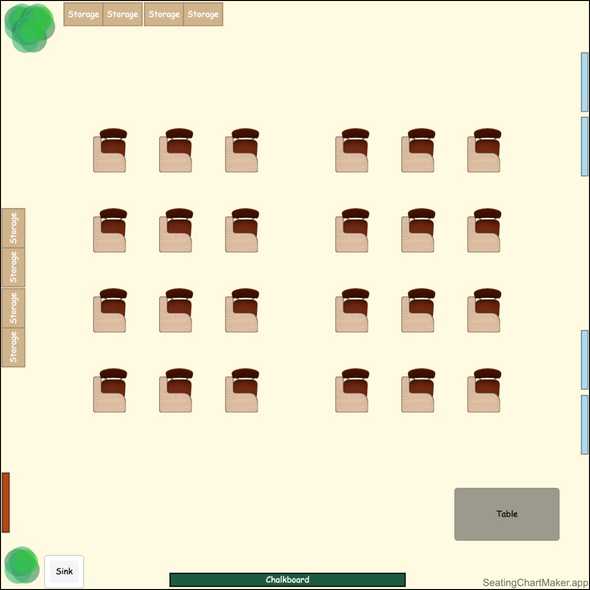
Figure 1. A 30 ft x 30 ft (900 sq ft) classroom with 24 desks in a grid formation. Create a custom layout to see different sizes and configurations in practice.
The average class size in the US is about 20 students (range: 15 to 26). At 900 square feet, that works out to roughly 45 square feet (4.2 m²) per student. This is based on the mean class size. Since most students attend classes larger than the mean, the typical student’s per-person space is somewhat less. This article focuses on US data, but includes international comparisons for context, including UK government guidelines.
- Average US classroom size: ~900 sq ft (84 m²)
- Typical range: 700 to 1,100 sq ft (65 to 102 m²)
- Common dimensions: 30 x 30 ft (9 x 9 m)
- Average students per class: ~20
- Space per student: ~45 sq ft (4.2 m²)
- US state minimums: 600 to 960 sq ft
- UK guideline (for 30 pupils): ~550 to 620 sq ft (50 to 58 m²)
Where do these numbers come from?
No single source covers US classroom sizes in full. The estimates in this article combine architectural publications, state building codes, education research, and calculations based on class-size data. Sources are referenced inline throughout and listed in full at the end.
I originally researched classroom sizes to set good defaults and templates for Seating Chart Maker users. I could not find a single reference that covers the topic completely, so I compiled data from state guidelines and architectural documents to build a fuller picture.
Some of the underlying data is sparse or inconsistent. Where exact figures are not available, the article says so.
How big is a typical US classroom?
Two types of evidence point to the same answer: direct reports from architectural sources and indirect estimates calculated from class-size data.
Reported classroom dimensions
According to Architectural Record, classrooms in many US schools range from 800 to 1,100 square feet (74 to 102 m²) and are planned for 20 to 30 students. Common sizes mentioned in the article:
- 28 by 30 feet: 840 sq ft (8.5 by 9 m: 76.5 m²)
- 30 by 30 feet: 900 sq ft (9 by 9 m: 81 m²)
- 32 by 32 feet: 1,024 sq ft (10 by 10 m: 100 m²)
These result in square or slightly rectangular rooms. The source article is about wood-framed school building design, but the figures are presented as general background, not specific to wood construction. The original data source is not specified, so treat these as indicative rather than definitive.
Tanner reports that a typical elementary classroom is about 900 square feet (84 m²), while a secondary school classroom is about 1,024 square feet (95 m²). Tanner also does not cite a specific source for these figures.
Estimating from class size data
We can cross-check the reported figures by working from class-size data.
There is no national standard for per-student classroom space in the US. State guidelines range from 25 to 45 square feet (2.3 to 4.2 m²) per student. The Illinois Administrative Code uses 35 square feet (3.3 m²) per student as its capacity formula.
The National Center for Education Statistics (NCES) reports an average class size of about 20 students, with most classes between 15 and 26 (see our class size statistics overview for more detail). Using the Illinois figure:
- 35 sq ft x 15 students = 525 sq ft (49 m²)
- 35 sq ft x 26 students = 910 sq ft (85 m²)
In practice, classrooms are built with extra capacity. Class sizes have also been declining slightly over time, meaning rooms built for larger classes now serve fewer students. The actual average likely sits above this calculated range.
This back-of-the-envelope check supports the ~900 sq ft average from the direct sources.
Minimum classroom size requirements by state
The US has no federal standard for classroom size. Individual states set their own minimums. Here is what several states require for standard (non-specialized) classrooms:
- California (Title 5): minimum 960 sq ft (89 m²) for grades 1 through 12. Schools must justify any classroom smaller than this.
- New York (NYSED): minimum 770 sq ft (72 m²) for elementary and secondary classrooms (up to 15 students), at 50 sq ft per student (4.6 m²). Rectangular layouts are preferred.
- Texas (TEA): minimum 700 sq ft (65 m²), with 28 to 36 sq ft per student (2.6 to 3.3 m²).
- Georgia (GaDOE): minimum 600 to 750 sq ft (56 to 70 m²).
- Pennsylvania (PA Code): 25 to 30 sq ft per student (2.3 to 2.8 m²).
- Illinois (Space Utilization Report): 25 to 45 sq ft per student (2.3 to 4.2 m²).
- New York City (NYC Health Dept): 17 to 22 sq ft per student (1.6 to 2.0 m²). Note: this is a different authority from the NYSED state-level requirement above, and the numbers are much lower.
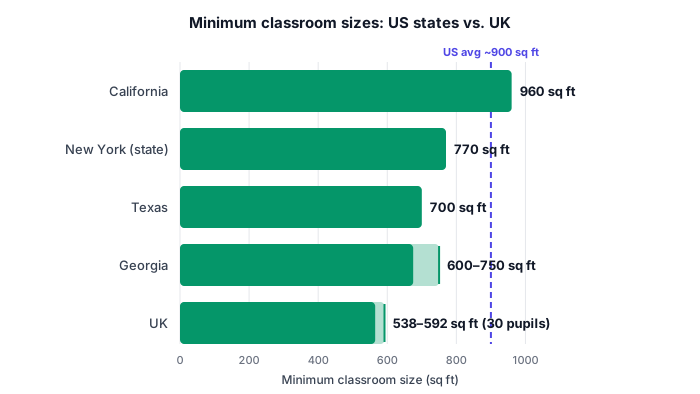
Figure 2. Minimum total classroom size required by several US states, with the UK (BB103) guideline and the estimated US average (~900 sq ft) shown for reference. Georgia and the UK are ranges, because the required minimum varies by grade level or room use.
State comparison table
| State | Avg class size | Min sq ft/student | Min total sq ft |
|---|---|---|---|
| California | 24 | - | 960 (89 m²) |
| New York (state) | 19 | 50 (4.6 m²) | 770 (72 m²) |
| New York City | 19 | 17-22 (1.6-2.0 m²) | - |
| Texas | 20 | 28-36 (2.6-3.3 m²) | 700 (65 m²) |
| Georgia | 20 | - | 600-750 (56-70 m²) |
| Pennsylvania | 21 | 25-30 (2.3-2.8 m²) | - |
| Illinois | 20 | 25-45 (2.3-4.2 m²) | - |
Table 1. Minimum classroom size requirements by US state, for standard (non-specialized) primary and secondary classrooms. Average class sizes are from NCES data. A dash means the state does not set that particular minimum.
This table covers primary and secondary classrooms only. It does not include specialized rooms such as science labs, art rooms, or music rooms. Average class sizes are from NCES data.
Some states set a per-student minimum (e.g., Pennsylvania, Illinois). Others set a total room minimum (e.g., California, Georgia). Texas provides both. The New York City Health Department figure (17 to 22 sq ft/student) is much lower than the NYSED state-level standard (50 sq ft/student) because they come from different authorities with different purposes.
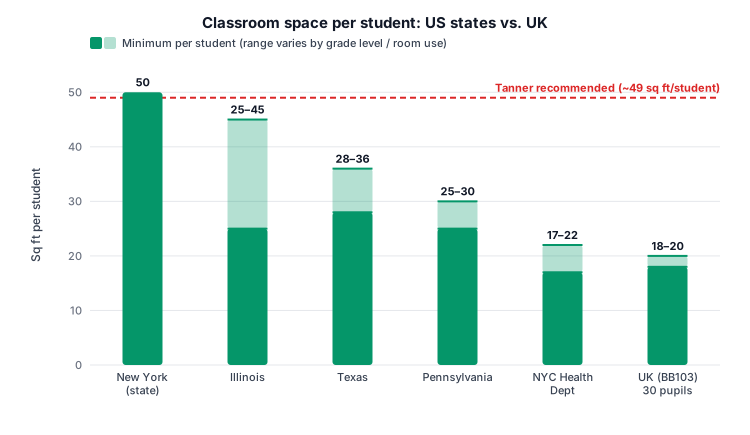
Figure 3. Minimum classroom space per student by US state, with the UK (BB103) for comparison. These are all minimums; where a range is shown, the required minimum varies by grade level or room use. Tanner's recommendation is marked for reference.
State minimums range from 600 to 960 square feet (56 to 89 m²). Actual classroom sizes are likely higher than these minimums, but it is also possible that schools tend to be built to the minimum.
How classroom size varies by grade level and subject
Classroom size is not one-size-fits-all. Both the age of the students and the subject being taught affect how much space is needed.
By grade level
Younger students generally get more space. This pattern appears in both US state guidelines and UK government recommendations (BB103). According to Georgia Department of Education guidelines:
- Grades K-3: 750 sq ft (70 m²)
- Grades 4-8: 660 sq ft (61 m²)
- Grades 9-12: 600 sq ft (56 m²)
Texas sets the same pattern in its building rules (TEA): prekindergarten through Grade 1 classrooms must be at least 800 sq ft (36 sq ft per student), while Grade 2 and up classrooms drop to 700 sq ft (32 sq ft per student at the elementary level, 28 at the secondary level). The youngest grades get the most space per child.
Younger children need more room for hands-on activities. They also tend to have more adults in the room (aides, specialists), which adds to the space needed.
By subject or activity
Specialized classrooms for subjects like science, art, and music are larger than standard classrooms (GaDOE). All other measurements in this article refer to regular classrooms unless stated otherwise.
UK government guidelines (BB103) provide specific size recommendations for different room types, which show the relative scale well. The table below uses UK data for groups of 30 pupils. While absolute sizes differ from the US, the proportional relationship between room types is likely similar.
| Room type | Area (m²) | Area (sq ft) | Relative to standard classroom |
|---|---|---|---|
| General classroom | 55 | 592 | 1.0x |
| Music classroom | 62 | 667 | 1.1x |
| General science lab | 83 | 894 | 1.5x |
| Specialist science lab | 90 | 969 | 1.6x |
| General art room | 83 | 894 | 1.5x |
| 3D art room | 97 | 1,044 | 1.8x |
| Drama studio | 90 | 969 | 1.6x |
| Resistant materials workshop | 104 | 1,119 | 1.9x (24 students) |
| Food room (practical cookery) | 104 | 1,119 | 1.9x (24 students) |
Table 2. UK room sizes by type relative to a standard classroom, for groups of 30 pupils (unless otherwise noted). Based on source: UK Department for Education, BB103.
The pattern is clear: science labs and art rooms need roughly 50% more space than a standard classroom. Workshops and food preparation rooms can be nearly double.
Texas (TEA) standards show similar proportion patterns. Against its 700 sq ft general-classroom minimum, it requires:
- Computer classroom: 900 sq ft (sized for 25 students)
- Combination science lab/classroom: 900 sq ft (elementary), 1,200 sq ft (middle), 1,400 sq ft (high school)
- Standalone science lab: 800 sq ft (elementary), 900 sq ft (middle), 1,000 sq ft (high school)
What size classroom do you need?
A simple way to estimate: multiply students by a flat per-student rate (e.g., 45 or 35 sq ft). But this overstates space needs for large classes and understates them for small ones. In reality, every classroom has fixed space (teacher’s desk, storage, pathways) that does not grow with enrollment. Each additional student adds seating area, but the overhead stays constant.
The UK’s BB103 guidelines use this principle explicitly. Their classroom size formulas follow the pattern: area = base + (rate x students). For a standard secondary classroom, BB103 uses:
- Lower bound: 2 + 1.6 x students = 50 m² (for 30 pupils)
- Upper bound: 4 + 1.7 x students = 55 m² (for 30 pupils)
US classrooms are roughly twice as large per student as UK classrooms. We can adapt the BB103 structure by scaling each formula to match known US data. Multiplying the compact formula by about 1.9 and the roomy formula by about 2.2, converting to square feet, and rounding gives:
- Roomy: area (sq ft) = 95 + 40 x students. At 20 students this gives 895 sq ft, matching the US average of ~900 sq ft.
- Compact: area (sq ft) = 40 + 33 x students. At 20 students this gives 700 sq ft, matching the Texas minimum.
The roomy formula has a larger base because a comfortable classroom allocates more fixed space to the teacher area, storage, and pathways. The compact formula has a smaller base and rate, reflecting tighter layouts.
Because of the fixed base, the effective per-student average decreases as class size grows. A class of 15 averages 46 sq ft/student in the roomy model. A class of 30 averages 43 sq ft/student. This matches real-world patterns: adding one student to a large class requires less marginal space than adding one to a small class.
Estimated classroom sizes for different class sizes
| Class size (S) | Roomy (95 + 40 x S) | Compact (40 + 33 x S) |
|---|---|---|
| 10 | 495 sq ft (22 x 23 ft) | 370 sq ft (19 x 20 ft) |
| 12 | 575 sq ft (24 x 24 ft) | 436 sq ft (21 x 21 ft) |
| 15 | 695 sq ft (26 x 27 ft) | 535 sq ft (23 x 23 ft) |
| 18 | 815 sq ft (29 x 28 ft) | 634 sq ft (25 x 25 ft) |
| 20 | 895 sq ft (30 x 30 ft) | 700 sq ft (26 x 27 ft) |
| 22 | 975 sq ft (31 x 31 ft) | 766 sq ft (28 x 28 ft) |
| 25 | 1,095 sq ft (33 x 33 ft) | 865 sq ft (29 x 30 ft) |
| 30 | 1,295 sq ft (36 x 36 ft) | 1,030 sq ft (32 x 32 ft) |
| 40 | 1,695 sq ft (41 x 41 ft) | 1,360 sq ft (37 x 37 ft) |
| 50 | 2,095 sq ft (46 x 46 ft) | 1,690 sq ft (41 x 41 ft) |
Table 3. Estimated classroom sizes for different class sizes, using the roomy and compact formulas above. Room dimensions are approximate, assuming a near-square layout. S = number of students.
Larger classes also tend toward lecture-style seating in rows, which fits more students in a given area. The formula doesn’t capture this effect, and thus works best for typical class sizes, not large lecture halls. Texas guidance (TEA) reflects this: large-group lecture spaces with no desks or tables need only 15 sq ft per student (1.4 m²), because lecture hall rows pack people more tightly.
Try Seating Chart Maker to design and test different layouts for your classroom size.
What does research say about ideal classroom size?
Tanner’s research proposes that the ideal classroom size is larger than what most schools currently have:
| Level | Current typical size | Tanner’s recommended size | Difference |
|---|---|---|---|
| Elementary (20 students + 1 teacher) | ~900 sq ft (84 m²) | 1,029 sq ft (96 m²) | +14% |
| Secondary | ~1,024 sq ft (95 m²) | 1,344 sq ft (125 m²) | +31% |
Table 4. Current typical classroom sizes versus the larger sizes recommended by Tanner, by school level.
Beyond raw floor area, Tanner found that classrooms should provide at least 72 square feet (6.7 m²) of window area for natural light. Views of the outdoors and direct outdoor access also support learning (Tanner and Heschong Mahone Group).
Criticism of this research
Tanner himself notes several limitations. His sizing metric relies on “social distance” between occupants, which is debatable as a design basis. There is also a correlation-versus-causation problem: schools with larger classrooms tend to have more resources overall, and those extra resources (not the room size itself) may explain better outcomes.
Even with these caveats, the research points in a useful direction. Current classrooms may benefit from more space. The ongoing trend toward smaller class sizes helps: if the room stays the same but holds fewer students, density improves.
Classroom sizes around the world
Classroom sizes vary widely across countries, driven by differences in class size norms, building traditions, and government standards.
United Kingdom (BB103 guidelines)
The UK offers the most detailed international comparison available. BB103 (“Area Guidelines for Mainstream Schools”) is a UK Department for Education guidance document (June 2014) that sets recommended area ranges for school buildings in England. It covers ages 3 through 19.
Unlike the US, which has no federal classroom-size standard, BB103 provides formulas for every room type. The standard assumed group size is 30 pupils, compared to the US average of about 20.
UK classroom sizes for 30 pupils
| Room type | Area | Area (sq ft) |
|---|---|---|
| Standard primary classroom | 50-55 m² | 538-592 sq ft |
| Extensive primary classroom | 55-62 m² | 592-667 sq ft |
| Semi-open primary classbase | 50-55 m² | 538-592 sq ft |
| Standard secondary classroom | 50-55 m² | 538-592 sq ft |
| Extensive secondary classroom | 55-62 m² | 592-667 sq ft |
| Secondary seminar room (22 pupils) | 37-41 m² | 398-441 sq ft |
Table 5. Recommended UK classroom sizes by room type, for 30 pupils. Source: UK Department for Education, BB103. These are recommendations for new builds and major renovations, not a census of existing rooms.
BB103 also specifies per-pupil basic teaching area allocations (covering all teaching spaces, not just one classroom):
- Primary: 2.0 m²/pupil (21.5 sq ft)
- Secondary (KS3/4): 2.9 m²/pupil (31.2 sq ft)
- Post-16: 3.2 m²/pupil (34.4 sq ft)
Rooms narrower than 7 m (23 ft) cannot be used efficiently according to BB103. Heavy practical rooms (food, workshops) need at least 7.8 m (25.6 ft) of depth.
This depth rule constrains room proportions. A standard 55 m² classroom with the 7 m minimum depth would be 7 x 7.9 m, nearly square (aspect ratio ~1:1.1). Standard classrooms are therefore limited to near-square layouts. By contrast, a 104 m² workshop at 7.8 m depth would be 7.8 x 13.3 m (aspect ratio ~1:1.7), a noticeably rectangular room. Similarly, an 83 m² science lab at 7 m depth would be 7 x 11.9 m (~1:1.7). The pattern: standard classrooms are roughly square, while specialized rooms can be more rectangular.
US vs. UK comparison
The difference is striking:
- A US classroom: ~900 sq ft (84 m²) for 20 students = 45 sq ft (4.2 m²) per student
- A UK classroom: ~592 sq ft (55 m²) for 30 pupils = 20 sq ft (1.8 m²) per pupil
UK classrooms are about 35% smaller in total area yet serve 50% more students. Per-student space in the UK is less than half the US figure. This reflects both the smaller class sizes in the US and the generally larger floor plans in American schools.
Asia (Korea, Japan, China)
A 2009 OECD study reports average class sizes of 31 students in Korea and 28 in Japan, both well above the US average of 20. More recent class size trends show Korean class sizes have since decreased. Larger class sizes likely mean larger total classroom areas, though per-student space may be similar to or less than US levels.
Reports from China describe classes exceeding 100 students, with about 20 sq ft (1.9 m²) per student. The classrooms themselves reach roughly 2,000 sq ft (186 m²), double the US average, but with half the per-student space.
Europe
European countries and Russia tend to have slightly smaller class sizes than the US on average (OECD 2009). The UK data above confirms that recommended classroom sizes in England are much smaller than US averages.
Direct room-size data for continental European countries is scarce. Most international comparisons report class size (number of students), not room size (square footage).
School desk dimensions for reference
Standard school desk sizes for reference when planning a layout. These are based on my research from public manufacturer data for Seating Chart Maker.
| Desk type | Size (inches) | Size (mm) |
|---|---|---|
| Regular school desk | 24 x 18 | 600 x 450 |
| Integrated desk with armrest | 20 x 12 + armrest | 500 x 300 + armrest |
| School lab desk | 48 x 24 | 1,200 x 600 |
Table 6. Common school desk dimensions.
Summary
The average US classroom is about 900 square feet (84 m²), with most falling between 700 and 1,100 square feet. At an average of 20 students per class, that is roughly 45 square feet per student.
Sizes vary by state (minimums range from 600 to 960 sq ft), grade level, subject, and country. UK classrooms are noticeably smaller at 50 to 62 m² for 30 pupils.
For different classroom configurations like grids, rows, or clusters, see our guide to classroom layout templates. To design a classroom layout with specific measurements, use Seating Chart Maker.
References
- Architectural Record, “Designing Modern Wood Schools”, January 2017.
- UK Department for Education, “BB103: Area Guidelines for Mainstream Schools”, June 2014.
- California Code of Regulations, Title 5, “School Facilities Construction”. Last reviewed on May 12, 2023.
- Georgia Department of Education, Facilities Services Unit, “Guideline for Square Footage Requirements for Educational Facilities”, May 2012.
- “Hadley Junior High School - Space Utilization Study Updates”, April 28, 2015.
- Mayer, Daniel P., Mullens, John E., and Moore, Mary T., “Monitoring School Quality: An Indicators Report”, National Center for Education Statistics, December 2000.
- National Teacher and Principal Survey, National Center for Education Statistics, “Average class size in public schools, by class type and state: 2017-18”.
- New York State Department of Health, Bureau of Emergency Medical Services, “Classroom Design Standards”, April 2010. (Also available at Scribd)
- Organisation for Economic Co-operation and Development, “Education at a Glance 2009: OECD Indicators”.
- Pennsylvania Code, § 59.33. Indoor/outdoor space.
- Sixth Tone, Wang Yiwei, “How China Manages Its Supersized Classrooms”, August 2, 2017.
- Tanner C. K., “Minimum Classroom Size and Number of Students Per Classroom”, September 1, 2009. (Available at Scribd)
- Texas Education Agency, “Commissioner’s Rules Concerning School Facilities”, April 2025.
- The State Education Department, The University of the State of New York, “State Building Aid for Public School Districts and BOCES”, June 2004. (Also available in PDF.)


